From fortress to palace
Philip II built a defensive castle beside the Seine. Charles V turned it into a royal residence, and Francis I rebuilt it as a Renaissance palace from 1546.
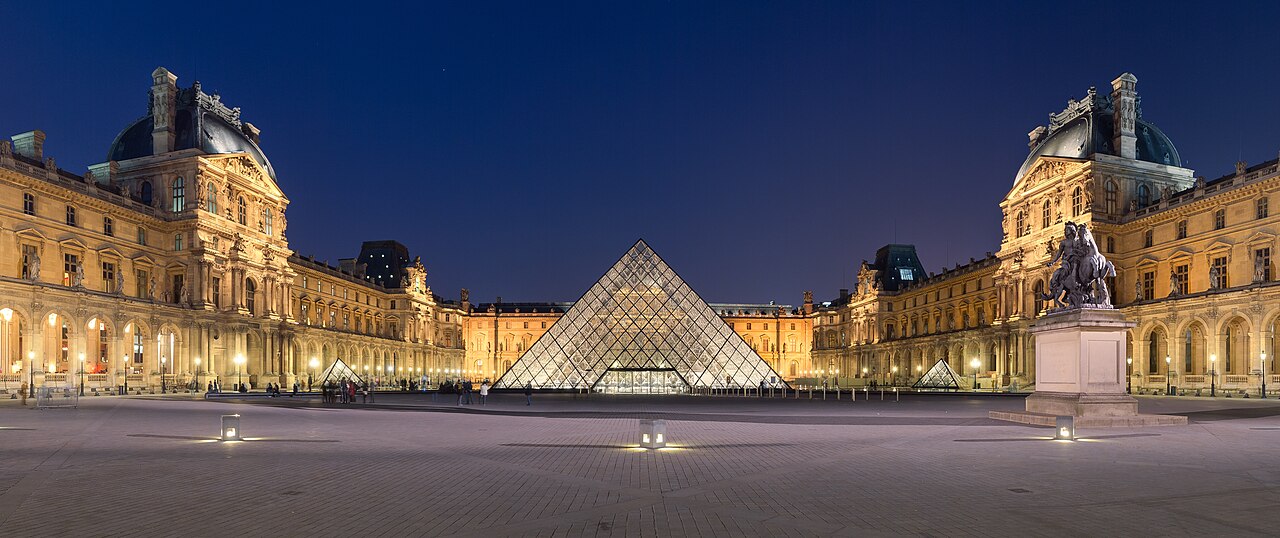
Nine thousand years of human making, gathered in a former royal palace on the right bank of the Seine. The largest art museum in the world, and the most visited.
The Louvre is the largest art museum in the world and the most visited. It occupies a former royal palace on the right bank of the Seine in Paris, and its collection spans nine thousand years of human making, from Mesopotamian law codes to nineteenth-century French painting.
The building began as a medieval fortress in 1190, became a royal residence under Charles V, and was rebuilt as a Renaissance palace from 1546. When Louis XIV moved the court to Versailles in 1682, the Louvre was left half-finished and occupied by academies and artists. It was the Revolution that turned it into a public museum, and Napoleon who made it the largest collection in Europe.
Today the museum is organised into eight curatorial departments across three wings — Denon, Sully and Richelieu — and its galleries cover more than 72,000 square metres. Around 35,000 works are on display at any one time, drawn from a collection of more than 615,000 objects.
Four moments that turned a riverside fortress into the most visited museum in the world.
Philip II built a defensive castle beside the Seine. Charles V turned it into a royal residence, and Francis I rebuilt it as a Renaissance palace from 1546.
One year after the fall of the monarchy, the revolutionary government opened the Musee central des arts in the Grande Galerie with 537 paintings, free to all citizens.
Napoleon filled the palace with works taken from across Europe and renamed it the Musee Napoleon. Two centuries later the Grand Louvre project doubled the galleries.
I. M. Pei’s pyramid opened in the Cour Napoleon, 21.6 metres high and built from 673 glass panes, giving the museum a modern entrance and a new emblem.
Twenty-five works are catalogued in this guide, from the Mona Lisa in the Salle des Etats to the Code of Hammurabi in the Richelieu wing.
The Louvre is not one building but a series of them, added, rebuilt and joined together over four hundred years.

The oldest surviving part of the palace, begun by Pierre Lescot under Francis I and completed over the following century. Its four facades read as a catalogue of French classical architecture, from the Renaissance to Perrault’s austere colonnade.

I. M. Pei’s pyramid is 21.6 metres high and 35 metres wide at its base, made of 673 glass panes. It leads down to a vast underground hall that distributes visitors to the three wings, and it has become the museum’s emblem.
Every work in this guide is listed with its medium, dimensions and the wing and room where it hangs, so you can follow the galleries from the Salle des Etats to the Salle des Caryatides.
The moments that shaped the building and the collection.
Philip II of France builds a defensive castle on the right bank of the Seine, outside the city wall. Its keep, the Grosse Tour, is 30 metres high and the moat is fed by the river. The building is called the Louvre, a name of uncertain origin.
Charles V converts the fortress into a comfortable palace, adding windows, gardens and a library. The medieval foundations of this castle were rediscovered in 1984 and can still be seen in the Salle Basse beneath the Cour Carree.
Francis I commissions the architect Pierre Lescot to rebuild the Louvre in the French Renaissance style. Lescot’s wing, with sculpture by Jean Goujon, becomes the model for the Cour Carree. Francis also begins the royal collection by acquiring Italian paintings, including works by Leonardo.
Louis XIV moves the royal court and government to Versailles. The Louvre is left half-finished and is occupied instead by academies and by artists who are given studios there. The Grande Galerie becomes a place where painters study the royal collection.


