About the museum

History & architecture of the Louvre

The Louvre is the largest art museum in the world and the most visited. It occupies a former royal palace on the right bank of the Seine in Paris, and its collection spans nine thousand years of human making, from Mesopotamian law codes to nineteenth-century French painting.

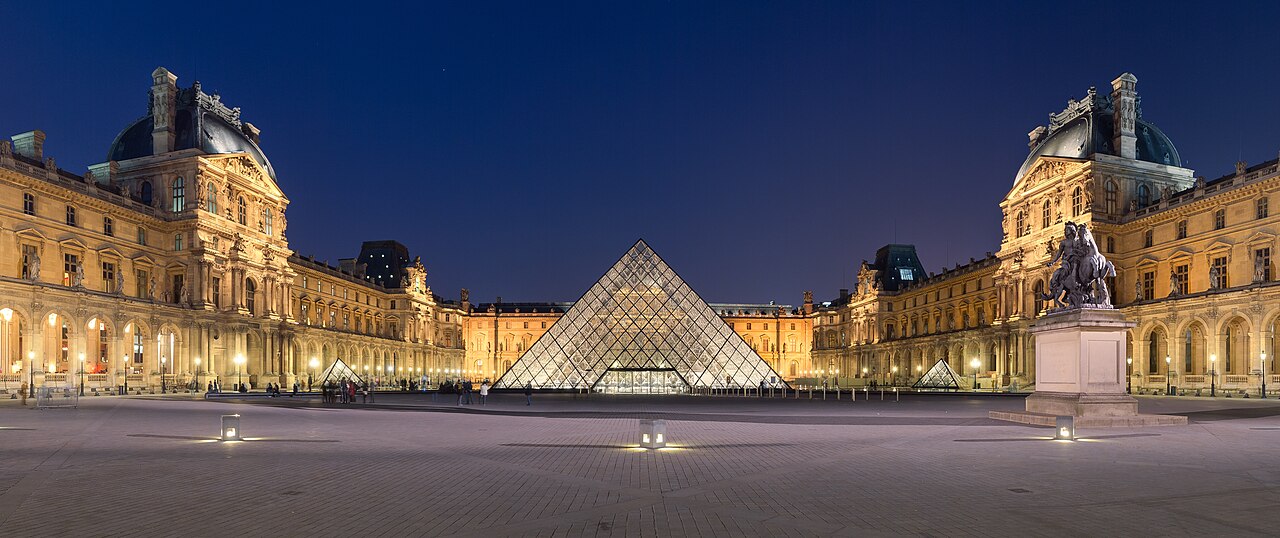
The Louvre palace and its glass pyramid seen across the Cour Napoleon in Paris
The Louvre palace and its glass pyramid, seen across the Cour Napoleon. Wikimedia Commons · Public domain
Origins

From a moated castle to a public museum

The name Louvre first appears in the twelfth century, attached to a fortress that Philip II built on the right bank of the Seine, just outside the city wall. Its purpose was defensive: a keep 30 metres high, a moat fed by the river, and a garrison to watch the approach to Paris from the west. The foundations of that castle were rediscovered in 1984 during the Grand Louvre works and can still be visited in the Salle Basse, beneath the Cour Carree.

Charles V turned the fortress into a residence in the 1360s, adding windows, gardens and a library. Two centuries later Francis I demolished the keep and commissioned Pierre Lescot to build a Renaissance palace on the same site. Francis also began the royal art collection, buying Italian paintings and inviting Leonardo da Vinci to France — the route by which the Mona Lisa entered the possession of the French crown.

When Louis XIV moved the court to Versailles in 1682, the Louvre was abandoned mid-construction. It was occupied instead by royal academies and by artists who were given lodgings and studios there, and the Grande Galerie became a place where painters could study the royal collection. That arrangement lasted more than a century, and it is the reason the building was already half a museum before the Revolution made it one.
The Revolution and the museum

On 10 August 1793 the National Convention opened the Musee central des arts in the Grande Galerie with 537 paintings, most of them former royal property. Entry was free for all citizens, three days a week. The museum was conceived as a public instrument of enlightenment, and its collection was organised and catalogued for the first time.

Napoleon and the Grand Louvre

Napoleon renamed the museum the Musee Napoleon and filled it with works taken by treaty and by conquest from Italy, the Low Countries, Spain and Egypt. Many were returned after 1815, but the ambition survived. In 1981 President Mitterrand launched the Grand Louvre project: the Ministry of Finance left the palace, the Richelieu wing opened in 1993, and the exhibition space roughly doubled.

The museum today

The Louvre holds more than 615,000 objects and displays around 35,000 of them across 72,735 square metres of galleries. It is organised into eight curatorial departments and three wings, and it welcomes roughly 8.7 million visitors a year — more than any other museum in the world.

Timeline

Eight centuries, eight moments

The dates that shaped the building and the collection it holds.

  1. 1190

    A fortress on the Seine

    Philip II of France builds a defensive castle on the right bank of the Seine, outside the city wall. Its keep, the Grosse Tour, is 30 metres high and the moat is fed by the river. The building is called the Louvre, a name of uncertain origin.

  2. 1364

    A royal residence

    Charles V converts the fortress into a comfortable palace, adding windows, gardens and a library. The medieval foundations of this castle were rediscovered in 1984 and can still be seen in the Salle Basse beneath the Cour Carree.

  3. 1546

    The Renaissance palace

    Francis I commissions the architect Pierre Lescot to rebuild the Louvre in the French Renaissance style. Lescot’s wing, with sculpture by Jean Goujon, becomes the model for the Cour Carree. Francis also begins the royal collection by acquiring Italian paintings, including works by Leonardo.

  4. 1682

    The court leaves for Versailles

    Louis XIV moves the royal court and government to Versailles. The Louvre is left half-finished and is occupied instead by academies and by artists who are given studios there. The Grande Galerie becomes a place where painters study the royal collection.

  5. 1793

    The museum opens

    On 10 August 1793, one year after the fall of the monarchy, the revolutionary government opens the Musee central des arts in the Grande Galerie. It displays 537 paintings, most of them former royal property. Entry is free for all citizens.

  6. 1803

    The Musee Napoleon

    Napoleon Bonaparte expands the collection enormously through conquest and treaty, filling the Louvre with works from Italy, the Low Countries, Spain and Egypt. The museum is renamed the Musee Napoleon and becomes the largest art collection in Europe. Many works are returned after 1815.

  7. 1989

    The glass pyramid

    The architect I. M. Pei completes the glass pyramid in the Cour Napoleon, 21.6 metres high and built from 673 glass panes. It becomes the museum’s new entrance and its most recognisable modern feature, and it frees the palace wings for galleries.

  8. 1993

    The Grand Louvre

    The Richelieu wing opens after the Ministry of Finance moves out of the palace, completing the Grand Louvre project begun by President Mitterrand in 1981. The museum’s exhibition space is roughly doubled and the whole building is finally devoted to art.

Architecture

Three parts of one palace

The Louvre is a sequence of buildings added, rebuilt and joined together over four hundred years, from a Renaissance courtyard to a glass pyramid.

The classical west facade of the Cour Carree of the Louvre Palace in Paris
1546-1660s

The Cour Carree

The oldest surviving part of the palace is built around a square courtyard on the eastern side. Pierre Lescot began the west wing in 1546 under Francis I; the other three sides were added over the following century, so the courtyard reads as a catalogue of French classical architecture, from Renaissance to the austere colonnade of Claude Perrault.

The Grande Galerie of the Louvre, a long vaulted hall lined with Italian paintings
1595-1610

The Grande Galerie

Henry IV built a long gallery along the Seine to connect the Louvre to the Tuileries Palace, a distance of some 450 metres. It was intended as a royal walkway and became the first home of the museum in 1793. Today it holds the Italian paintings, including Botticelli and the early Renaissance panels.

The glass pyramid of the Louvre illuminated at night in the Cour Napoleon
1989

The Pyramid

I. M. Pei’s pyramid is 21.6 metres high and 35 metres wide at its base, made of 673 glass panes held in a steel and aluminium frame. It sits at the centre of the Cour Napoleon and leads down to a vast underground hall that distributes visitors to the three wings. It was controversial when it opened and is now the museum’s emblem.

The collection

Eight curatorial departments

The museum is divided by civilisation and by medium, and each department has its own galleries, study rooms and specialists.

Egyptian Antiquities

More than 50,000 objects from the Nile valley, from prehistory to the Coptic period, including the Seated Scribe and the Great Sphinx of Tanis.

Near Eastern Antiquities

The art and archaeology of Mesopotamia, Iran and the Levant, from the earliest cities to the Achaemenid empire. The Code of Hammurabi is its most famous object.

Greek, Etruscan and Roman Antiquities

Sculpture, vases, bronzes and jewellery from the classical world, including the Venus de Milo, the Winged Victory and the Borghese collection.

Islamic Art

Some 18,000 works from Spain to India, from the seventh to the nineteenth century, displayed in a dedicated department created in 2003.

Sculpture

French and Italian sculpture from the Middle Ages to the nineteenth century, including Michelangelo’s Slaves and Canova’s Psyche.

Decorative Arts

Furniture, ceramics, tapestries, metalwork and the French crown jewels, tracing the interiors of the French court from the Middle Ages to the nineteenth century.

Paintings

Around 7,500 works from the thirteenth to the mid-nineteenth century, arranged by national school: Italian, French, Northern European, Spanish and British.

Prints and Drawings

A study collection of some 200,000 works on paper, shown in rotating displays because of their sensitivity to light.

Walk the galleries

Twenty-five masterpieces, each with its medium, dimensions and the wing and room where it hangs.

Explore the collection