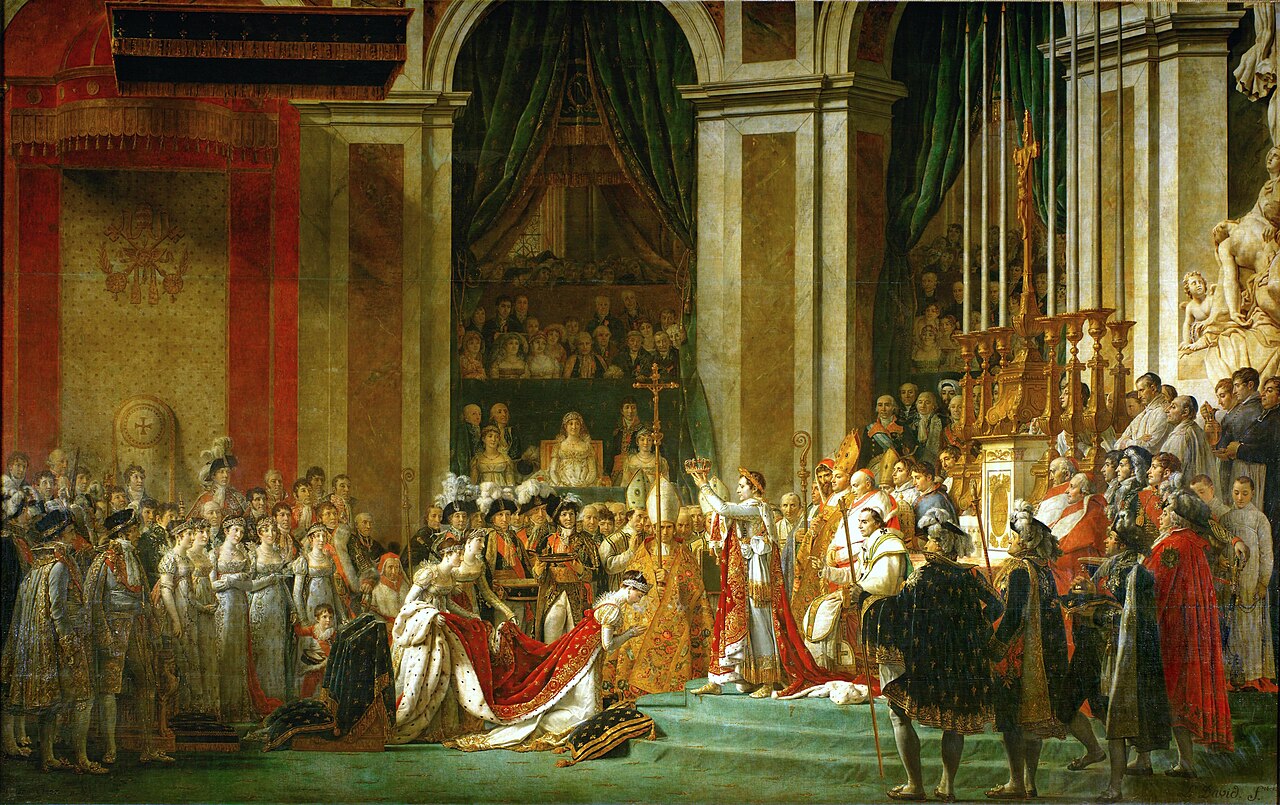
Jacques-Louis David’s Coronation of Napoleon is one of the largest paintings in the Louvre and one of the most carefully stage-managed images in European art. It records the ceremony of 2 December 1804 in Notre-Dame, but not as it happened: David, who had been Napoleon’s official painter since 1804, rearranged the composition so that the Emperor appears at the moment of crowning Josephine rather than crowning himself, and he placed Napoleon’s mother in the centre of the tribune even though she had stayed in Rome.
The canvas is nearly ten metres wide and contains over a hundred identifiable figures, each of whom sat for the artist. David made dozens of preparatory drawings and a full-scale cartoon, and he built a wooden model of the tribune so that he could work out the perspective. The result is a painting that reads like a photograph of an event that never quite took place - a piece of political theatre painted with the precision of a history painting.
Napoleon fell before the painting was finished, and David, who had voted for the death of Louis XVI, went into exile in Brussels in 1816. The painting was removed from the Louvre during the Restoration and only returned in 1837, when it was re-hung as a historical document rather than a celebration.