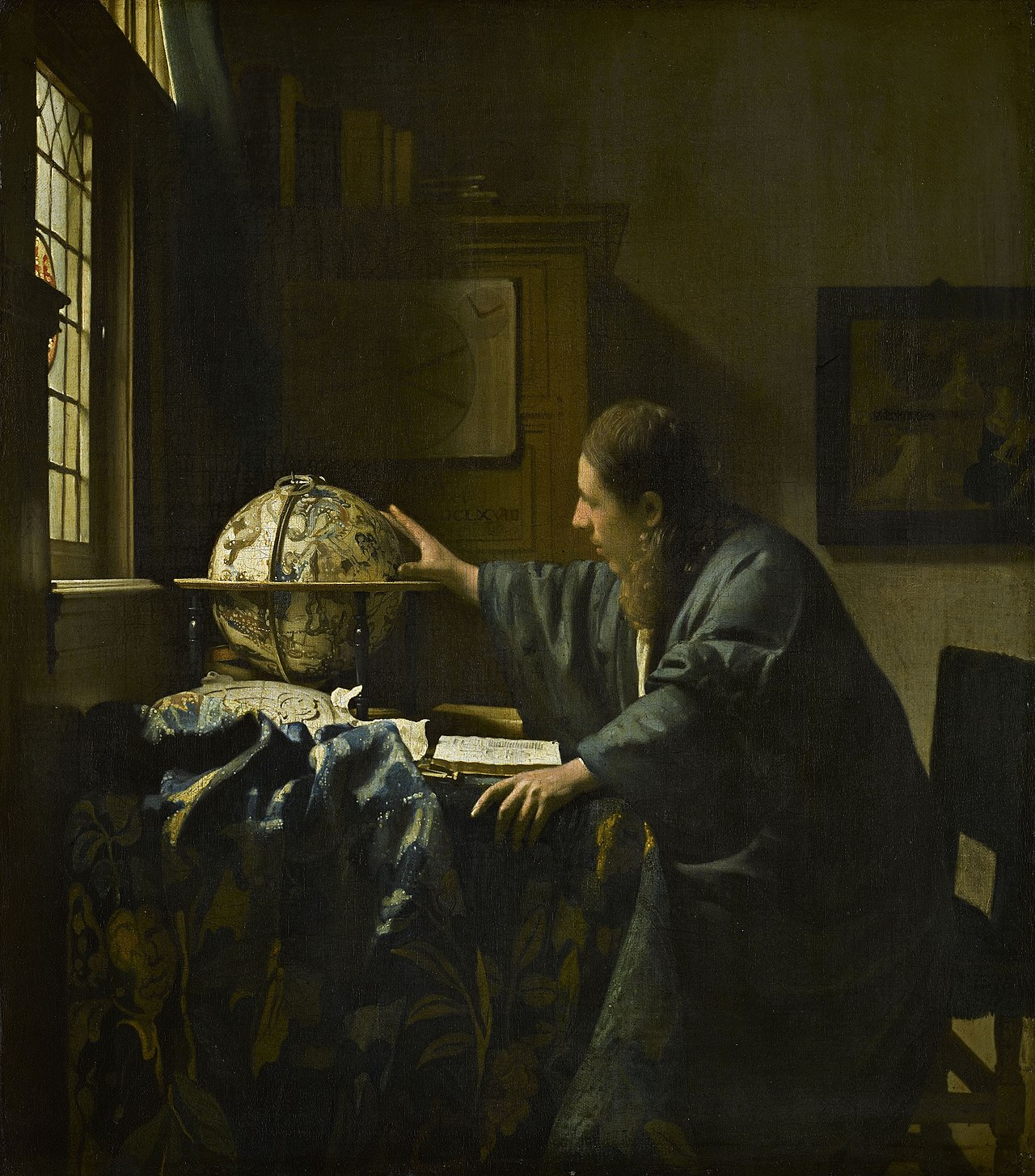
Portrait of the Artist at His Easel by Rembrandt van Rijn

Wikimedia Commons · Public domain

PaintingDutch Golden Age

Portrait of the Artist at His Easel

Rembrandt van Rijn
Date
1660
Medium
Oil on canvas
Dimensions
111 x 85 cm (44 x 33 in)
Period
Dutch Golden Age
Type
Painting
Location in the Louvre
Richelieu Wing · Level 2 · Dutch Paintings, Room 844
Inventory number
INV 1747
About the work

Portrait of the Artist at His Easel

Rembrandt painted himself more than forty times, and this canvas of 1660 is one of the last and most searching. He stands at his easel, palette and brushes in hand, a maulstick resting against his arm, looking out at the viewer with an expression that is difficult to read: patient, wary, perhaps amused. He is fifty-four, bankrupt, and living in a rented house in Amsterdam.

The painting is built out of a very narrow range of browns, ochres and greys, with the light concentrated on the face and hands. Rembrandt’s late technique - thick impasto on the lit passages, thin translucent glazes in the shadows - gives the skin a physical weight that no earlier portrait quite achieves. The background is a dark, undefined space, so that the figure seems to be standing in his own studio and nowhere else.

The picture was in the French royal collection by the early eighteenth century and was one of the works that made Rembrandt’s name in France. It has been in the Louvre since 1793 and is one of the museum’s most visited Dutch paintings.

The artist

Rembrandt van Rijn (1606-1669) was born in Leiden, the son of a miller, and became the most successful portrait painter in Amsterdam in the 1630s. He spent extravagantly on art and objects, was declared insolvent in 1656, and continued to paint and etch through his final decade. His self-portraits form the longest visual autobiography in the history of art.

Historical context

The Dutch Republic had no royal patron, so painters depended on the market. Rembrandt’s late style - rough, dark and psychologically intense - went out of fashion in his own lifetime, and he died in poverty. French collectors rediscovered him in the eighteenth century, and the Louvre’s holdings, built on the royal collection, made Paris a centre of Rembrandt studies.

Where to find it

Richelieu Wing · Level 2 · Dutch Paintings, Room 844

The Louvre is divided into three wings — Denon, Sully and Richelieu — reached from the hall beneath the glass pyramid.