The Lacemaker by Johannes Vermeer

Wikimedia Commons · Public domain

PaintingDutch Golden Age

The Lacemaker

Johannes Vermeer
Date
c. 1669-1671
Medium
Oil on canvas (mounted on panel)
Dimensions
24.5 x 21 cm (9.6 x 8.3 in)
Period
Dutch Golden Age
Type
Painting
Location in the Louvre
Richelieu Wing · Level 2 · Dutch Paintings, Room 837
About the work

The Lacemaker

The Lacemaker is the smallest painting Vermeer ever made, and one of the most concentrated. A young woman bends over her work, a bobbin in each hand, her attention entirely absorbed by the lace she is making. In front of her is a sewing cushion with a pattern book and a blue thread; behind her, a blurred wall. The whole painting is about the act of looking closely at something.

Vermeer’s technique here is extraordinary. The woman’s hair, the bobbins and the threads are painted with tiny dabs of paint that dissolve into abstraction when seen from close up and resolve into perfect clarity from a distance - an effect that anticipates the Impressionists by two centuries. The foreground is deliberately out of focus, so that the eye is pulled to the one sharp point where the bobbins meet.

The painting was probably made around 1669-1671, late in Vermeer’s short life, and it was sold in Amsterdam in 1696 as part of the Dissius collection. It entered the Louvre in 1870 as part of the bequest of Baron Louis La Caze, a physician and collector whose gift transformed the museum’s holdings of Dutch and Spanish painting.

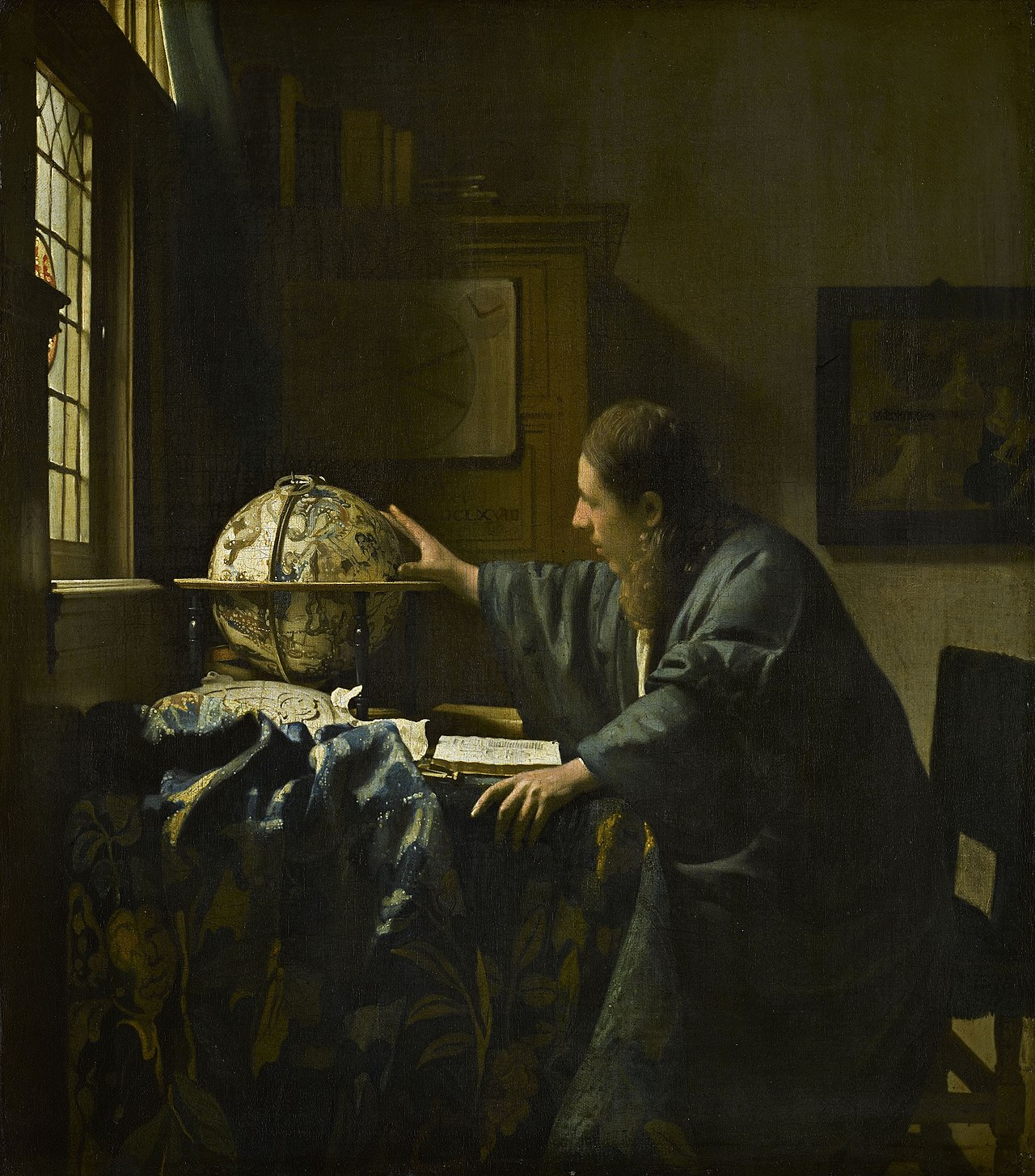
The artist

Johannes Vermeer (1632-1675) spent his whole life in Delft, where he ran his father’s inn and dealt in art. He painted fewer than forty surviving works, most of them quiet interior scenes lit from a window on the left. He was largely forgotten after his death and was rediscovered in the nineteenth century, when his handling of light and his possible use of the camera obscura became the subject of intense study.

Historical context

The Dutch Golden Age produced a market for small, affordable paintings of everyday life, and Vermeer worked at the top of that market for a small circle of collectors. The La Caze bequest of 1869-70 gave the Louvre a group of Dutch and Spanish pictures that had been almost unknown in public, and it helped establish Vermeer’s modern reputation in France.

Where to find it

Richelieu Wing · Level 2 · Dutch Paintings, Room 837

The Louvre is divided into three wings — Denon, Sully and Richelieu — reached from the hall beneath the glass pyramid.