The Astronomer by Johannes Vermeer

Wikimedia Commons · Public domain

PaintingDutch Golden Age

The Astronomer

Johannes Vermeer
Date
1668
Medium
Oil on canvas
Dimensions
51 x 45 cm (20 x 18 in)
Period
Dutch Golden Age
Type
Painting
Location in the Louvre
Richelieu Wing · Level 2 · Dutch Paintings, Room 837
About the work

The Astronomer

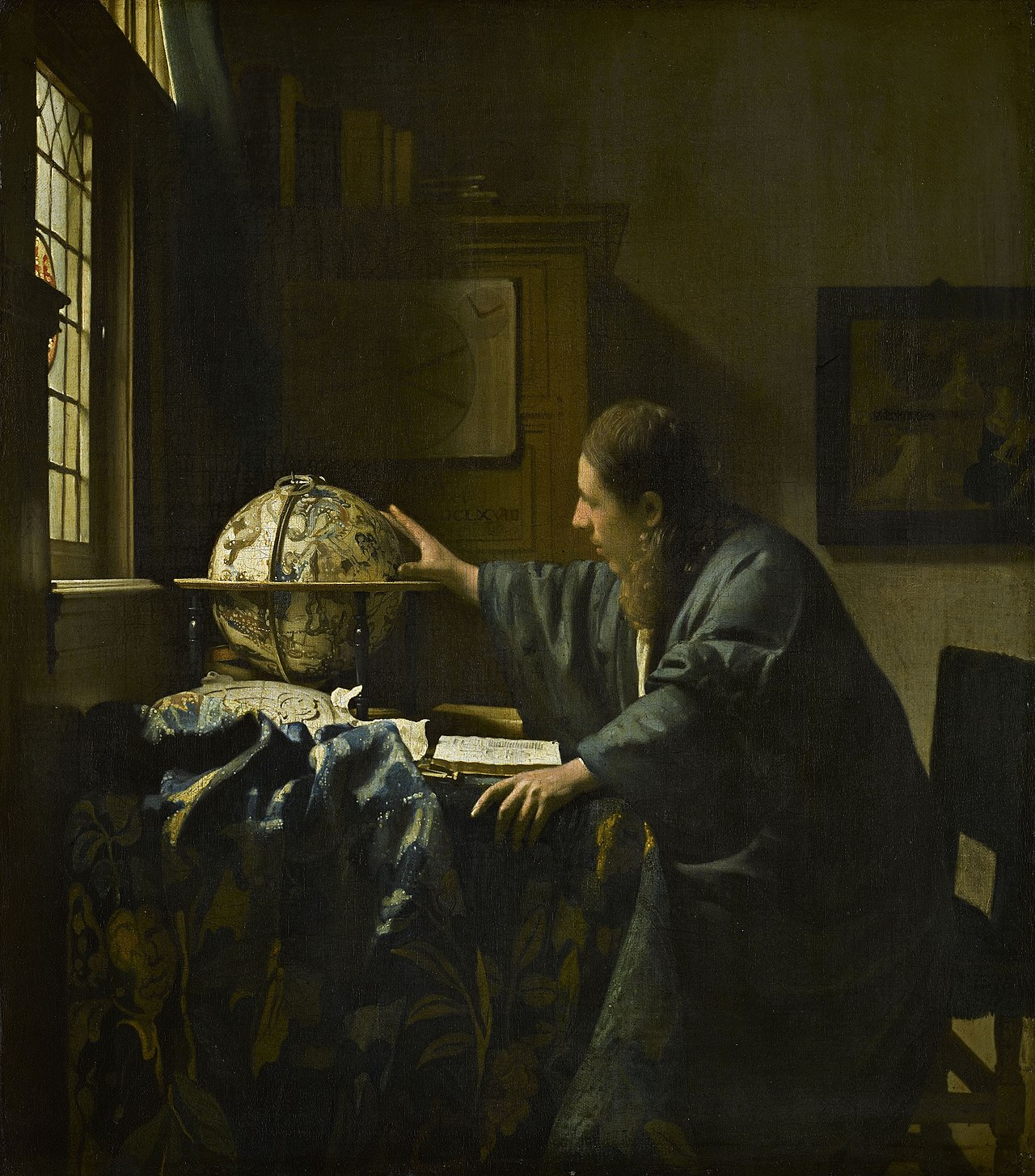
The Astronomer shows a young man in a scholar’s robe standing at a table, one hand resting on a celestial globe, the other on the table beside it. He is not looking at the globe but past it, out of the window, as if following a thought. On the wall behind him is a cupboard, and on the table a book, an astrolabe and a chart. The light comes from a window on the left and falls across the globe, the man’s face and the folds of his robe.

The painting is one of a pair with The Geographer in Frankfurt, and both are usually identified as the same model - possibly Antonie van Leeuwenhoek, the Delft draper and microscopist who was a friend of Vermeer’s and later became famous as a scientist. The globe in the painting is by Jodocus Hondius and shows the constellations of the northern sky.

Vermeer’s interest here is the relationship between knowledge and light. The astronomer is surrounded by instruments, but the painting is not about measurement; it is about the moment of understanding, when a man stops looking at his tools and looks up. The work was acquired for the French royal collection in 1785 and has been in the Louvre since 1793.
The artist

Johannes Vermeer (1632-1675) painted interiors, women, music and light, and only rarely men. He was a Catholic convert in a Protestant city, a head of the painters’ guild in Delft, and a man who died in debt. His surviving output is tiny, and The Astronomer and The Geographer are the only two paintings in which he takes a scholar as his subject.

Historical context

The Dutch Republic in the 1660s was a centre of astronomy, cartography and instrument-making, and Delft was a city of engineers and lens-grinders. Vermeer’s painting reflects the intellectual culture of the Dutch Golden Age, in which trade, science and art were closely connected. It was bought for Louis XVI in 1785 and entered the Louvre at the museum’s foundation in 1793.

Where to find it

Richelieu Wing · Level 2 · Dutch Paintings, Room 837

The Louvre is divided into three wings — Denon, Sully and Richelieu — reached from the hall beneath the glass pyramid.